
Spore Probiotics and Regular Probiotics are both live beneficial bacteria taken to support gut health, but they come from completely different bacterial families and behave very differently once you swallow them.
Regular probiotics are built around lactic acid bacteria, mostly strains from the Lactobacillus and Bifidobacterium families. These are the strains found in yogurt, kefir, and the majority of probiotic supplements sold in pharmacies.
They are active, living organisms at the time of consumption. Their survival through the digestive tract depends on the product’s formulation, the dose, and what you eat alongside them.
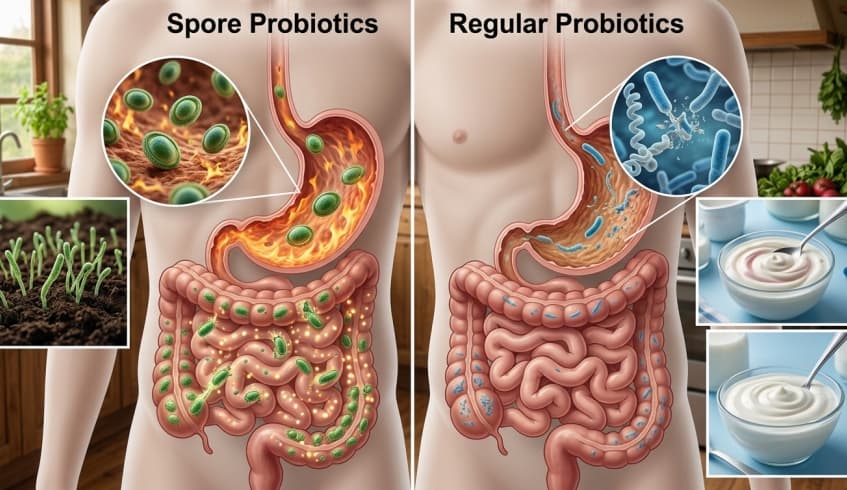
Spore probiotics are built around Bacillus strains, most commonly Bacillus coagulans, Bacillus subtilis, and Bacillus clausii. These bacteria form a structure called an endospore: a tough, dormant seed like casing that surrounds and protects the bacterial cell.
The endospore does not activate until it detects the temperature, pH, and moisture conditions of the lower intestine. Until then, it is essentially inert, making it impervious to stomach acid, heat, oxygen, and most conditions that destroy conventional probiotic strains.
Think of regular probiotics as fresh fruit and spore probiotics as dried seeds. The fruit is nutritious and ready to eat, but it bruises easily and spoils fast.
The seed looks inert, but it carries everything it needs inside a protective shell, and it only opens when conditions are exactly right.
The Survivability Problem: Why Most Regular Probiotics Never Reach the Gut
The single biggest challenge for regular probiotics is surviving the journey from your mouth to your colon.
The stomach maintains a pH between 1.5 and 3.5, which is acidic enough to destroy most bacteria. Research using a dynamic gastric model found that survival rates for Lactobacillus strains in water ranged from just 1.0 to 43.8 percent, depending on the strain and conditions.
Strains perform significantly better when taken with food, particularly fat containing meals, which buffer stomach acidity. Lactobacillus and Bifidobacterium tend to survive best when taken with food or up to 30 minutes before a meal.
This variability creates a real problem. A product label may say 10 billion colony forming units (CFU), but that number reflects what is in the capsule, not what reaches your gut.
Many conventional probiotic products deliver a fraction of their stated dose to the site where they are supposed to work.
Spore probiotics sidestep this entirely. The Bacillus endospore is not a living cell in the way that Lactobacillus is. It does not need nutrients, oxygen, or protection during transit because its metabolism is fully suspended.
It passes through stomach acid unchanged, then germinates in the more favorable environment of the small and large intestines. This is why spore probiotic manufacturers can market their products as arriving 100 percent viable at the target site.
How Each Type Works in the Gut
Probiotics do not all work the same way in the gut, and understanding their effects can help you decide which type makes the most sense.
How Regular Probiotics Work
Lactobacillus and Bifidobacterium strains that survive the stomach can adhere to the lining of the intestinal wall.
Some strains form temporary biofilms in the gut, where they compete with harmful bacteria for space and nutrients. They produce lactic acid and other organic acids that lower the local pH, making the environment less hospitable to pathogens.
They also interact with immune cells lining the gut wall, helping calibrate the immune response.
The key limitation is that Lactobacillus and Bifidobacterium are transient residents even at their best. They do not permanently colonize the gut in most healthy adults. Regular supplementation is needed to maintain their effects.
How Spore Probiotics Work
Bacillus spores germinate in the intestine and become metabolically active bacteria. Once active, they produce a range of compounds including enzymes, antimicrobial peptides, and antioxidants.
They do not adhere to the intestinal wall the way Lactobacillus does, but they influence the gut environment in a different way.
Research shows spore probiotics act as microbial conductors rather than permanent residents. A 2021 study found that over a three week period, spore probiotics increased bacterial diversity in the gut as well as keystone species including Akkermansia muciniphila and Bifidobacterium.
Rather than replacing native gut bacteria, they appear to create conditions in which beneficial native species can thrive.
A landmark clinical trial at the University of North Texas tested spore probiotics against metabolic endotoxemia (also called leaky gut syndrome, a condition where bacterial toxins cross the gut barrier into the bloodstream).
After 30 days of supplementation with a five strain Bacillus blend, participants who experienced endotoxin spikes after high fat meals showed significant reductions in those spikes.
Spore Probiotics vs Regular Probiotics: A Clear Comparison
| Feature | Regular Probiotics | Spore Probiotics |
|---|---|---|
| Main strains | Lactobacillus, Bifidobacterium | Bacillus coagulans, subtilis, clausii |
| Survivability through stomach | Variable: 1 to 44 percent in water | Near 100 percent via endospore shell |
| Refrigeration required | Usually yes | No; shelf stable at room temperature |
| Heat resistance | Low; most strains die above 115 to 120 degrees F | Very high; some strains tested up to 455 degrees F |
| Gut colonization | Temporary adherence to intestinal wall | Transient; no long term colonization |
| Research depth | Extensive; decades of clinical trials | Growing; most research from 2010 onward |
| Best established uses | Antibiotic diarrhea, vaginal health, infant gut, IBS | IBS, leaky gut, metabolic endotoxemia, immune modulation |
| SIBO safety | Risk of worsening symptoms in some cases | Generally safer; spores activate only in the colon |
| Cost | $15 to $50 per month depending on brand | $25 to $60 per month depending on brand |
| CFU dosage range | 1 billion to 100 billion CFU common | 1 billion to 10 billion CFU typical |
Who Should Choose Spore Probiotics
Spore probiotics are a better fit in the following situations.
- You have tried regular probiotics and seen little or no improvement in symptoms.
- You take antibiotics frequently and want a probiotic that survives alongside antibiotic treatment (Bacillus spores are naturally resistant to many antibiotics that kill Lactobacillus).
- You have small intestinal bacterial overgrowth (SIBO). Regular probiotics add active bacteria to the small intestine, which can worsen SIBO. Spore probiotics remain dormant until they pass the small intestine, so they do not contribute to the overgrowth.
- You travel frequently and cannot reliably refrigerate your supplements.
- You want a probiotic that supports broad microbial diversity rather than seeding specific strains.
Who Should Choose Regular Probiotics
Regular probiotics are the better established choice in these situations.
- You are taking or have recently completed a course of antibiotics and want to reduce diarrhea risk. Lactobacillus rhamnosus GG has the strongest evidence for this specific use.
- You are an infant or are supplementing an infant, where Bifidobacterium strains are the natural dominant bacteria.
- You are managing bacterial vaginosis or recurrent vaginal infections where Lactobacillus strains are the target organisms.
- You are eating probiotic rich foods like yogurt or kefir and want a supplement that mirrors and extends those same strains.
- You want access to the widest range of strain options and the largest body of clinical data.
Can You Take Both Types Together?
Yes. Taking spore probiotics and regular probiotics together is the basis of a clinical approach called triple probiotic therapy, popularized by integrative gastroenterologist Dr. Michael Ruscio.
The protocol combines spore based Bacillus strains, a Lactobacillus and Bifidobacterium blend, and Saccharomyces boulardii (a yeast probiotic) simultaneously.
The idea behind this combination is that each type targets different parts of the gut and works through different mechanisms.
Spore probiotics improve microbial diversity and address gut barrier function. Regular probiotics seed specific beneficial species and support the intestinal wall lining directly. The yeast component provides anti pathogen effects and supports immune regulation.
This approach is not necessary for everyone. Someone with mild digestive complaints and no specific condition may see adequate results from one type used consistently.
But for people with complex or persistent gut issues, combining types under medical supervision may provide broader support than either type alone.
Conclusion
Spore probiotics and regular probiotics are not competitors for the same job. They work through different mechanisms, target different aspects of gut health, and have their strongest evidence in different conditions.
If survivability and shelf stability are your priorities, or if you have SIBO or have not responded to regular probiotics, spore probiotics are the logical starting point.
If you are recovering from antibiotics, managing a vaginal health condition, or want the backing of the largest clinical evidence base, regular probiotics with well studied strains like Lactobacillus rhamnosus GG or Bifidobacterium infantis are the more direct choice.
For complex gut conditions, both types used together offer the broadest coverage available without a prescription.