
Positional obstructive sleep apnea is a type of obstructive sleep apnea (OSA) in which breathing interruptions occur mostly when a person sleeps on their back.
When lying face up, gravity causes the tongue and soft tissue in the throat to fall backward, narrowing the airway and leading to pauses in breathing.
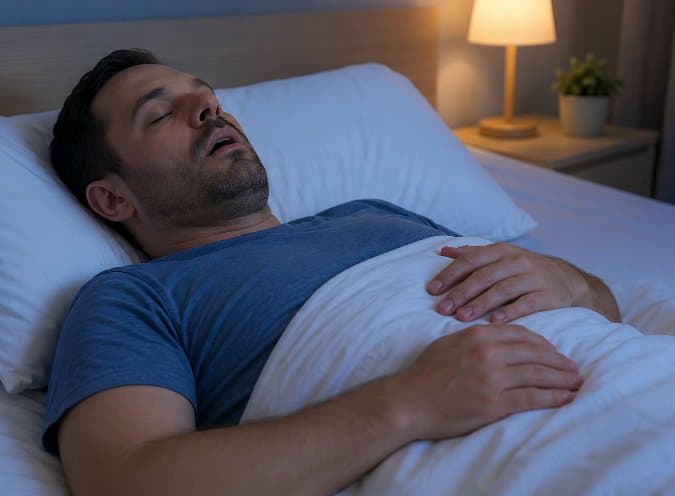
Doctors generally define POSA as an apnea hypopnea index (AHI) that is at least twice as high in the supine position, meaning lying flat on the back, compared to other sleep positions. The AHI measures how many times per hour breathing stops or becomes shallow during sleep.
This pattern matters because it changes the treatment picture. A person whose apnea almost disappears when sleeping on their side has more options than someone whose airway collapses in every position.
See Also: How to Sleep After Stopping Trazodone?
What Causes Positional Obstructive Sleep Apnea?
Positional obstructive sleep apnea happens because lying on the back lets the tongue, soft palate, and throat tissue fall backward into the airway. Several physical and lifestyle factors make this more likely.
Anatomy of the airway. A naturally narrow throat, a large tongue, or enlarged tonsils leaves less room for tissue to shift before it blocks airflow.
Body weight and neck size. Extra fat around the neck and throat adds pressure on the airway when a person lies flat. Excess weight as one of the strongest risk factors for any form of OSA.
Muscle tone during sleep. Muscles in the throat relax during sleep, and that relaxation is more likely to cause a collapse when gravity is also pulling tissue backward.
Age and sex. POSA is more common in younger and leaner OSA patients, and several studies report it more often in men, though it also occurs in women.
Signs and Symptoms of Positional Obstructive Sleep Apnea
The symptoms of positional obstructive sleep apnea overlap closely with general sleep apnea symptoms, but they often improve when a person avoids sleeping on their back.
- Loud snoring that is noticeably worse or only present when lying face up.
- Choking or gasping sounds during sleep, usually reported by a bed partner.
- Morning headaches and a dry mouth on waking.
- Excessive daytime sleepiness, even after a full night in bed.
- Difficulty concentrating or irritability during the day.
- Waking up frequently during the night without a clear reason.
A bed partner often notices these signs before the person with apnea does, since the choking and snoring happen during sleep.
How Doctors Diagnose Positional Obstructive Sleep Apnea
Diagnosis requires a sleep study that records breathing, oxygen levels, and body position throughout the night. This can be done in a sleep lab (polysomnography) or at home with a portable monitor.
The key diagnostic step is comparing the AHI in the supine position against the AHI in non supine positions. A home sleep apnea test can be appropriate for many adults with a suspected straightforward case, while a lab based study is recommended when other conditions are suspected.
| Diagnostic Criteria | Definition | What It Means |
|---|---|---|
| Overall AHI | Total breathing pauses per hour, all positions combined | Confirms presence and severity of OSA |
| Supine AHI | Breathing pauses per hour while on the back | Measures severity specific to back sleeping |
| Non supine AHI | Breathing pauses per hour in side or stomach sleeping | Shows how much position affects severity |
| Positional ratio | Supine AHI divided by non supine AHI | A ratio of 2 or higher generally confirms POSA |
Treatment Options for Positional Obstructive Sleep Apnea
Treatment for positional obstructive sleep apnea ranges from simple positional training to standard OSA therapies, and the right choice depends on severity and whether apnea fully resolves outside the back sleeping position.
| Treatment | How It Works | Best For | Considerations |
|---|---|---|---|
| Positional therapy device | A wearable sensor or belt vibrates or nudges the user away from back sleeping | Mild to moderate POSA confirmed by sleep study | Does not help if apnea still occurs while side sleeping |
| CPAP (continuous positive airway pressure) | A machine delivers steady air pressure through a mask to keep the airway open | Moderate to severe OSA, including positional and non positional cases | Considered the most reliable option, but some people find it hard to use consistently |
| Oral appliance therapy | A custom mouthpiece repositions the jaw and tongue to keep the airway open | Mild to moderate cases, or people who cannot tolerate CPAP | Requires fitting by a dentist trained in sleep medicine |
| Weight management | Reducing body weight lowers pressure on the airway from neck and throat tissue | People with excess weight contributing to airway narrowing | Works best alongside another treatment, not usually as a stand alone fix |
| Upper airway surgery | Removes or repositions tissue that blocks the airway | Cases where anatomy is the main driver and other treatments have not worked | Reserved for select cases after other options are tried |
Positional therapy can be considered as an alternative for patients with mild to moderate OSA who show a strong positional pattern, but CPAP remains the first line treatment for moderate to severe disease.
How to Manage Positional Obstructive Sleep Apnea at Home
These steps reflect common recommendations from sleep medicine sources and can support, though not replace, a doctor confirmed treatment plan.
- Get a proper diagnosis first. Schedule a sleep study so the supine and non supine AHI values are documented before trying any home strategy.
- Try a positional therapy device. Wear a vibrating positional alarm or a position restricting band at night to train the body away from back sleeping.
- Adjust the sleep setup. Use a wedge pillow or place a pillow behind the back to make rolling onto the back less comfortable.
- Track sleep position over time. Some positional devices log data so progress can be reviewed with a doctor at follow up visits.
- Address contributing weight factors. Work with a healthcare provider on a weight management plan if excess weight is part of the picture.
- Limit alcohol and sedatives before bed. These relax throat muscles further and can worsen airway collapse in any position.
- Follow up with a sleep specialist. Repeat testing after a few months confirms whether the chosen approach is working or whether CPAP or another therapy is needed.
Conclusion
Positional obstructive sleep apnea responds well to treatment once it is properly identified.
The supine versus non supine AHI comparison from a sleep study is what separates a true positional case from general obstructive sleep apnea, and that distinction shapes every decision that follows, from a simple positional device to full CPAP therapy.
Anyone with loud snoring, witnessed breathing pauses, or unexplained daytime sleepiness should talk to a doctor about a sleep study before trying any home fix on its own.