
Ascorbic acid and L-ascorbic acid are the same thing in almost every product you can buy. Both names mean vitamin C, the exact form your body uses.
The “L” only names the shape of the molecule. The one real catch is a lookalike called erythorbic acid, which has only about 5% of vitamin C’s activity.
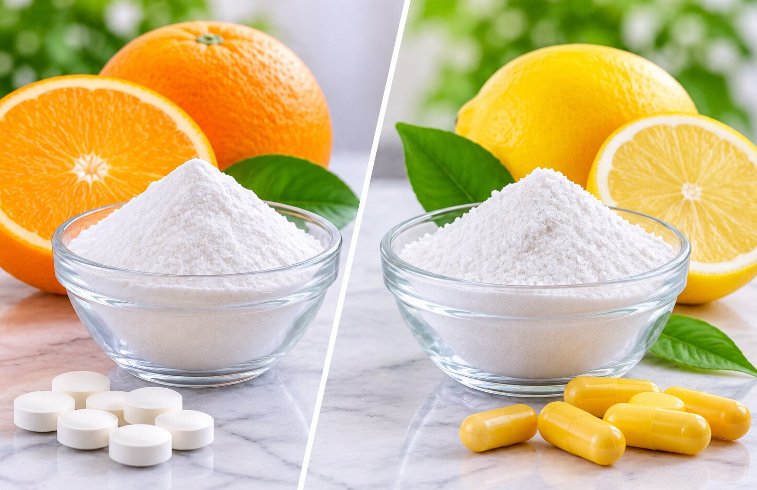
Ascorbic Acid and L-Ascorbic Acid: Similarities and Differences
There is no practical difference. “Ascorbic acid” is the short name and “L-ascorbic acid” is the full chemical name for the same molecule. Vitamin C and L-ascorbic acid as one and the same.
So why do two names exist? Chemists use the full name when they need to be exact. Everyone else drops the “L” because the other forms almost never show up in real products.
Skincare brands often print “L-ascorbic acid” on the front of the bottle. That is mostly marketing. It tells you the serum contains pure vitamin C instead of a derivative. The molecule inside is the same one sold as “ascorbic acid” in a vitamin tablet.
See More: Spore Probiotics Vs Regular Probiotics: Pros, Cons, and Differences
Why the “L” is There at All
The “L” stands for levo, a label for one of two mirror image shapes. Think of your hands. Your left and right hands have the same parts, but you cannot stack one perfectly on top of the other. Ascorbic acid works the same way.
Both shapes have the same formula: six carbons, eight hydrogens, and six oxygens. But your body’s enzymes and transporters are shaped to fit only one of them well. Nature makes the L form. That is the form fruits and vegetables contain and the form your cells are built to use.
L-Ascorbic Acid vs D-Ascorbic Acid vs Erythorbic Acid
L-ascorbic acid is the only one of these three that works fully as vitamin C. D-ascorbic acid is its exact mirror image.
Erythorbic acid is a close cousin with one carbon flipped. Both are only partly active as vitamin C, and both are poorly held by your tissues and cleared quickly.
| Compound | Other Names | Vitamin C Activity | Where You Find It |
|---|---|---|---|
| L-ascorbic acid | Ascorbic acid, vitamin C, E300 | Full | Fruits, vegetables, supplements, serums, fortified foods |
| D-ascorbic acid | Mirror image of vitamin C | Partial, cleared quickly | Research labs, not standard consumer products |
| Erythorbic acid | Isoascorbic acid, D-araboascorbic acid, E315 | About 5% of L-ascorbic acid | Cured meats, processed fish, some drinks |
Erythorbic acid deserves the most attention because you may actually eat it. Food makers use it as an antioxidant to keep color and freshness in processed meat and fish.
It had no effect on how the body absorbs or clears vitamin C. It does help the body absorb nonheme iron, much like vitamin C does.
The takeaway is simple. Erythorbic acid protects the food. It does not supply your daily vitamin C.
Is Synthetic Ascorbic Acid the Same as Natural Vitamin C?
Yes. The ascorbic acid in supplements is chemically the same as the vitamin C in food. Supplement ascorbic acid has the same bioavailability as the vitamin C in orange juice and broccoli. Your body cannot tell where the molecule came from.
Most commercial vitamin C starts as glucose, often from corn. Modern plants use updated versions of that process, often with bacterial fermentation steps. These methods produce the L form, the same one plants make.
A “natural” vitamin C label usually means the product includes whole food powders such as acerola or camu camu. Those powders bring extra plant compounds. But the vitamin C molecule inside them is still L-ascorbic acid.
How to Read “Ascorbic Acid” on a Product Label
The word “ascorbic acid” means L-ascorbic acid on all three common label types. What changes from label to label is the company it keeps.
Knowing where you see the word tells you what else to check for, whether that is a mineral salt, a stability booster, or a preservative lookalike.
On a Supplement Facts Panel
“Vitamin C (as ascorbic acid)” means plain L-ascorbic acid. Other common forms include sodium ascorbate, calcium ascorbate, other mineral ascorbates, and ascorbic acid with bioflavonoids. Ester C is a branded blend that contains calcium ascorbate and vitamin C breakdown products.
Research has not shown that any one oral form is better than the others. Choose based on cost, stomach comfort, and any limits on sodium or calcium your doctor has set.
On a Skincare Ingredient List
On the back label, “Ascorbic Acid” is the official ingredient name for pure vitamin C. It is the same ingredient the front of the bottle may call “L-ascorbic acid.”
The back label uses INCI names (International Nomenclature of Cosmetic Ingredients), and that system lists it simply as Ascorbic Acid.
If the list shows a different name, the product uses a derivative instead. Common ones include magnesium ascorbyl phosphate, sodium ascorbyl phosphate, ascorbyl glucoside, ascorbyl palmitate, and tetrahexyldecyl ascorbate.
On a Food Package
On food packaging, E300 is L-ascorbic acid. E301 is sodium ascorbate and E302 is calcium ascorbate. E304 refers to ascorbyl palmitate, a fat soluble form used to keep oils from going rancid.
Watch for E315 (erythorbic acid) and E316 (sodium erythorbate). These look similar on paper. They are preservatives, not a source of vitamin C.
L-Ascorbic Acid in Skincare: Why the Formula Matters More Than the Name
In skincare, a serum’s pH and concentration decide whether L-ascorbic acid reaches your skin. The most cited study on this, done on pig skin, found that L-ascorbic acid only raised skin levels when the formula’s pH was below 3.5. Delivery improved as the pH dropped toward 2.0.
The reason is chemistry. L-ascorbic acid has a pKa of 4.2. Below that point, more of the molecule stays uncharged, and an uncharged molecule passes into skin more easily.
The same study tested concentrations from 5% to 30%. Skin levels peaked at 20%. Going higher did not add more.
Skin levels were saturated after three daily applications, and the vitamin C stayed in the skin with a half life of about four days.
In that study, three derivatives did not raise skin levels of L-ascorbic acid: magnesium ascorbyl phosphate, ascorbyl palmitate, and dehydroascorbic acid.
Keep in mind this was one animal study with small groups. Newer derivatives have been developed since, and formulas have changed.
How to Tell if a Vitamin C Serum Has Oxidized
A pure L-ascorbic acid serum starts clear or pale yellow. As it reacts with air, light, and heat, it turns darker yellow, then orange, then brown. A deep orange or brown color means much of the vitamin C has broken down.
To slow this down, keep the cap tight and store the bottle somewhere cool and dark. Buy smaller bottles you can finish in a few months. Serums that pair L-ascorbic acid with vitamin E and ferulic acid are designed to hold up longer.
Ascorbic Acid vs Vitamin C Derivatives and Mineral Ascorbates
Pure L-ascorbic acid is the most studied form, but it is also the least stable in water. Derivatives and mineral salts trade some of that research history for better shelf life or a gentler feel.
The right choice depends on whether you are swallowing it or putting it on your skin.
| Form | Used In | What It Is | Practical Note |
|---|---|---|---|
| L-ascorbic acid | Supplements, serums, foods | Pure vitamin C | Most studied form; breaks down fast in water based serums |
| Sodium ascorbate | Supplements, foods (E301) | Vitamin C bound to sodium | Less acidic taste; adds sodium |
| Calcium ascorbate | Supplements, foods (E302) | Vitamin C bound to calcium | Less acidic; adds calcium |
| Ascorbyl palmitate | Foods (E304), skincare | Vitamin C bound to a fatty acid | Fat soluble; did not raise skin vitamin C in Pinnell et al., 2001 |
| Magnesium ascorbyl phosphate | Skincare | Stable water soluble derivative | Gentler on skin; did not raise skin vitamin C in Pinnell et al., 2001 |
| Ascorbyl glucoside | Skincare | Vitamin C bound to glucose | Stable; converts to vitamin C after it enters skin |
| Tetrahexyldecyl ascorbate | Skincare | Oil soluble derivative | Common in oils and creams; less clinical data than L-ascorbic acid |
For sodium ascorbate, the extra sodium is small but real. Based on its molecular weight, 1,000 mg of sodium ascorbate carries roughly 115 mg of sodium. That matters if you follow a low sodium diet.
For skin, people with sensitive skin often find the low pH of L-ascorbic acid stings. A derivative can be a gentler starting point, even if its evidence base is thinner.
How Much Ascorbic Acid Do You Need Each Day?
Adult men need 90 mg of vitamin C a day and adult women need 75 mg. People who smoke need 35 mg more each day, because smoking speeds up how fast the body uses vitamin C. These numbers apply to ascorbic acid and L-ascorbic acid alike, since they are the same nutrient.
Your body absorbs about 70% to 90% of vitamin C at moderate intakes of 30 to 180 mg a day. Absorption drops as doses get larger, and the extra leaves in your urine.
The upper limit for adults is 2,000 mg a day. Going above it can cause diarrhea and stomach upset. Most people reach their daily needs with fruits and vegetables such as citrus, red and green peppers, kiwifruit, and broccoli.
Conclusion
You do not need to choose between ascorbic acid and L-ascorbic acid. They are the same vitamin C, sold under a short name and a full chemical name. Any product that lists either one gives you the form your body uses.
The labels worth reading closely are the ones that list something else. On food, E315 and E316 are preservatives. In supplements, mineral ascorbates add sodium or calcium.
In skincare, derivatives trade some research support for stability. Once you know these names, a vitamin C label takes seconds to read.