
Powdered collagen is dry hydrolyzed collagen that you stir into a drink or food. Liquid collagen is the same kind of peptide already dissolved in water or a flavored base. The real differences are collagen per serving, added ingredients, price per gram, and how easy each form is to take every day.
Hydrolyzed means the large collagen protein has been cut into short pieces called peptides. Think of a long rope that cannot fit through a small gap.
Cut into short lengths, the same rope passes through easily. Raw collagen molecules are large and hard for the body to absorb, which is why most supplements are hydrolyzed first.
Both formats can use different animal sources, such as bovine (cow), marine (fish), porcine (pig), or chicken. Source matters for allergies and personal preference. The skin trials used mostly marine collagen, with 14 of the 26 trials testing it.
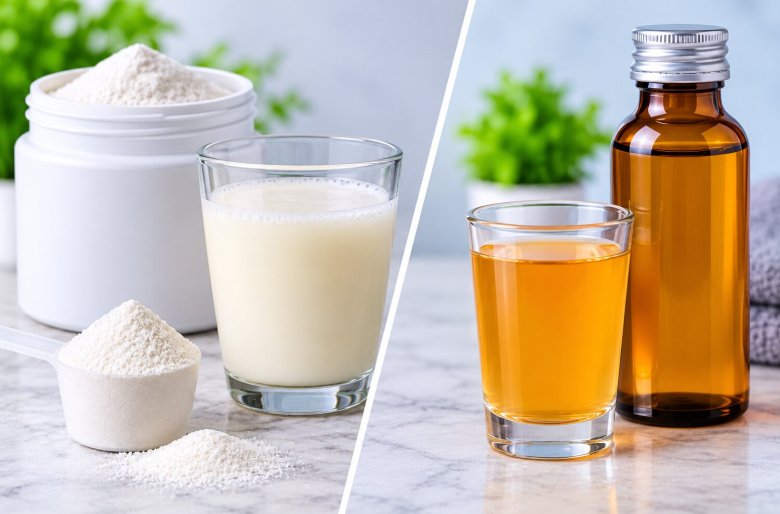
Is Liquid Collagen Absorbed Better Than Powder?
No. No strong scientific evidence shows that liquid collagen is absorbed better than powder. What determines absorption is whether the collagen was hydrolyzed into small peptides, not whether it is sold as a scoop or a bottle.
Powder turns into a liquid the moment you stir it into water or coffee. By the time it reaches your stomach, a dissolved powder and a liquid supplement are in the same state.
Human blood tests show what happens next. Short peptides containing hydroxyproline, an amino acid abundant in collagen, appear in plasma after people consume collagen hydrolysate. One of these peptide forms peaked about 2 hours after ingestion and then declined.
Some brands advertise figures such as 90% absorption for liquid and 30% for powder. These numbers come from marketing material, and sellers who list them do not point to published trials that tested the two formats head to head.
A fair note on speed: some sellers say liquid digests faster. Even if that is true, collagen is a daily supplement that works over weeks, so a faster first hour matters little.
Check This: Bone Broth Protein Powder vs Whey Protein Powder
How Much Collagen Do You Get per Serving?
Powder usually delivers more collagen per serving than liquid. One brand lists about 5 g of collagen in a tablespoon of powder and about 1.5 g in a tablespoon of liquid. Those are one company’s figures, so check the supplement facts panel on any product you buy.
Dose matters because trials used specific amounts. The studies in the Pu et al. review tested daily doses of 2.5 g, 5 g, 10 g, and 12 g, among others. A liquid with 1.5 g per tablespoon would need more than 3 tablespoons to reach 5 g.
More is not always better. No significant straight line relationship between daily dose and skin improvement. A product with a clear, labeled dose in the range tested in trials is a better target than the highest number on the shelf.
Does One Form Have Better Evidence for Skin Results?
Neither form has better evidence, because trial results were not sorted by powder versus liquid. Subgroup comparisons abstract looked at collagen source and treatment length, not format. The evidence supports collagen peptides as an ingredient, whatever the container.
Here is what the two largest recent pooled analyses found:
- Combined 26 randomized controlled trials with 1,721 participants. Hydrolyzed collagen improved skin hydration and elasticity compared with placebo.
- Use longer than 8 weeks showed a larger hydration effect than use shorter than 8 weeks, with effect sizes of 0.59 and 0.39.
- Found the most reproducible gains in hydration, elasticity, and skin barrier function. They did not find reliable evidence for fewer wrinkles or thicker dermal density once outliers were accounted for.
- Also identified several sources of bias in the included trials, and called for standardized products and studies lasting at least 24 weeks.
How Do Cost, Taste, and Convenience Compare?
Powder usually costs less per gram of collagen, while liquid costs more and removes the mixing step. The only reliable way to compare is to divide the price by the total grams of collagen in the container.
Here is illustrative math, not real market prices. A $30 tub holding 300 g of collagen costs $0.10 per gram. A $30 bottle with 30 servings of 3 g holds 90 g, which costs about $0.33 per gram.
Taste and texture are the other trade off. Some people find powder chalky or clumpy, and plain collagen dissolves best in warm drinks, smoothies, and yogurt. Liquid skips that step but often adds sweeteners and flavoring, so check the sugar line on the label.
The best format is the one you will take daily. Trials ran for weeks, and longer use showed larger hydration gains. A cheaper powder you skip is worth less than a bottle you finish.
Are There Safety Concerns With Either Form?
Collagen peptides are generally well tolerated, and the main risks come from product quality and allergies, not from powder or liquid itself.
Reported side effects are usually mild digestive complaints such as bloating or a feeling of fullness. Talk to your doctor before starting if you have a medical condition, take medication, or are pregnant or breastfeeding, since research in pregnancy is limited.
Allergy is the clearest risk. Marine collagen comes from fish, so people with fish or shellfish allergy should avoid it, and bovine or chicken collagen carries its own allergen concerns. Read the ingredient list for both forms.
Contamination is the second concern. Dietary supplements are not approved by the US Food and Drug Administration (FDA) before they are sold, so quality varies by brand.
Fish and jellyfish collagen supplements tested for lead, cadmium, chromium, mercury, and arsenic. None of the samples exceeded EU limits, and some had no detectable metals. The authors still urged updated food safety rules for cumulative exposure.
Look for third party testing, such as NSF International or USP certification, on whichever format you pick.
How to Choose Between Powder and Liquid Collagen
Choose powder if your priority is the most collagen per dollar, and choose liquid if convenience is the reason you will actually take it. Use these steps to decide.
- Check the supplement facts panel and write down grams of collagen per serving, not the total serving size.
- Divide the price by total grams of collagen to get cost per gram.
- Confirm the label says hydrolyzed collagen or collagen peptides.
- Match the source (bovine, marine, porcine, or chicken) to your allergies and diet.
- Check for added sugar, sweeteners, and preservatives, especially in liquid products.
- Look for third party testing from a recognized certifier.
- Plan to use it daily for at least 8 weeks before judging results.
Conclusion
Powdered collagen vs liquid collagen comes down to dose, price, and habit. Absorption does not separate them, and the skin research tested collagen peptides rather than a particular format. If you want the most collagen per dollar, powder is the practical pick.
Choose liquid if a ready to drink bottle is what keeps you consistent. Whichever you buy, confirm the label says hydrolyzed collagen, check the grams per serving, and give it at least 8 weeks before judging results.