
Raw mushrooms preserve nutrients that heat breaks down, particularly vitamin C, thiamin, and some B vitamins.
Six large raw white mushrooms contain about 24 calories and 1.1 grams of fiber, and they hold onto roughly twice the riboflavin, vitamin B6, and folate of the same mushrooms once cooked.
The appeal of raw mushrooms comes down to three things: nutrient retention, texture, and convenience. Sliced raw mushrooms add crunch to a salad without any prep time beyond washing and slicing.
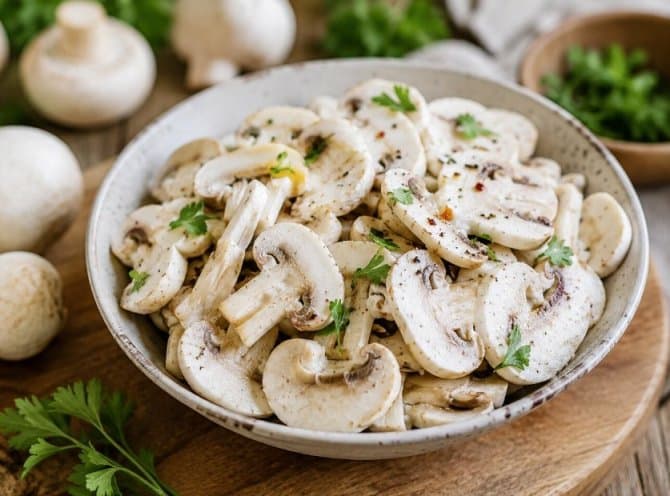
For people trying to cut cooking oil or reduce added sodium, raw mushrooms also test lower in sodium than the same mushrooms after boiling, since boiling concentrates sodium loss into the cooking water.
Raw vs Cooked Mushrooms: A Nutrient by Nutrient Comparison
Neither raw nor cooked mushrooms win across every category. The table below breaks down what changes when heat is applied.
| Nutrient or Factor | Raw Mushrooms | Cooked Mushrooms | Source |
|---|---|---|---|
| Vitamin C and B vitamins | Higher retention | Partially destroyed by heat | |
| Potassium bioavailability | Locked in tough cell walls | Increased, easier to absorb | |
| Sodium | Higher per mushroom | Roughly one fifth as much after boiling | |
| Agaritine (potential carcinogen) | Present at full level | Reduced 35 to 70 percent depending on method | |
| Digestibility | Harder due to chitin cell walls | Easier, cell walls break down | |
| Iron content | Lower | Higher |
The pattern is consistent. Raw mushrooms hold onto more of the vitamins that heat destroys.
Cooked mushrooms release more of the minerals that are physically trapped behind chitin, the same tough material found in insect shells and crustacean exoskeletons.
Which Mushrooms Are Safe to Eat Raw?
Most mushrooms sold in grocery stores can be eaten raw in moderation, but not all mushrooms should be.
Safe raw options include white button, cremini, oyster, and lion’s mane mushrooms, since they contain fewer harmful compounds and have a texture that is easy to chew raw.
Wild foraged mushrooms are a different situation entirely. Morels and false morels contain toxins that can cause serious illness or death if eaten raw, and some species require thorough cooking just to become edible at all.
Shiitake mushrooms also deserve a specific warning: eating them raw or undercooked has been linked to a delayed skin reaction called shiitake dermatitis, which can appear up to ten days after the mushroom was eaten.
Stick to cultivated mushrooms from a grocery store or reputable farmers market, eat them raw only in small portions, and never eat a wild mushroom raw unless an expert has confirmed both the species and its safety.
Does Agaritine in Raw Mushrooms Cause Cancer?
Agaritine is a naturally occurring compound in white button, cremini, and portobello mushrooms that has shown carcinogenic activity in mouse studies, but the risk to humans appears small.
One estimate from Swiss researchers put the added lifetime cancer risk from typical mushroom consumption at around two cases per 100,000 people.
Cooking meaningfully lowers agaritine levels. Microwaving for just one minute cuts agaritine content by roughly 65 percent, and even 30 seconds removes about half.
Boiling and frying also reduce agaritine, though boiling transfers some of the compound into the cooking liquid rather than eliminating it.
How to Eat Raw Mushrooms Safely
Eating raw mushrooms safely comes down to preparation, portion, and mushroom choice. Slice mushrooms thin before eating them raw, since smaller pieces are easier to chew and digest given their tough chitin cell walls.
A short acidic marinade, such as lemon juice, vinegar, or a vinaigrette, can soften mushroom texture and make raw mushrooms gentler on digestion.
Always inspect mushrooms for sliminess, dark spots, or an ammonia like smell before eating them raw, since spoiled mushrooms carry a higher risk of causing stomach upset regardless of species.
Start with a small portion, such as a quarter cup sliced into a salad, rather than a large raw serving. This lets you gauge how your digestive system responds before eating raw mushrooms as a regular habit.
Conclusion
Raw mushrooms are not inherently dangerous, but they are not automatically the healthier choice either.
Raw preserves certain vitamins, while cooking unlocks minerals and lowers agaritine exposure. For most people, a small amount of raw white button, cremini, or oyster mushroom in a salad is perfectly reasonable.
For wild mushrooms, reishi, boletus, and anything you cannot confidently identify, cooking is not optional.