
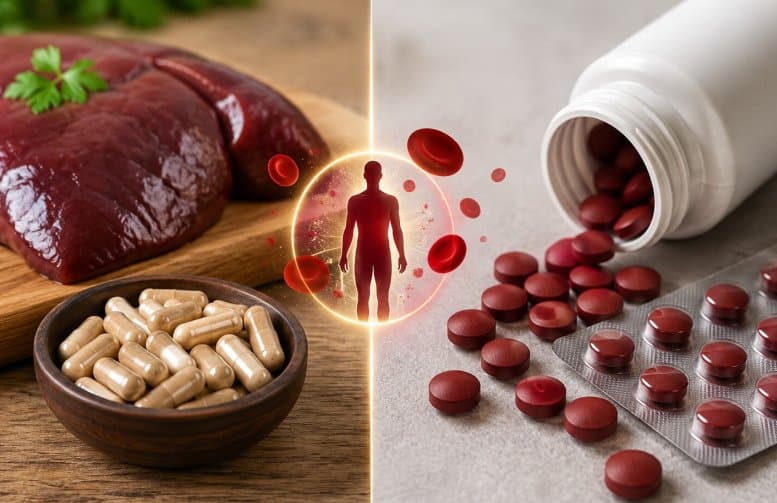
Beef liver supplements are freeze dried or desiccated organ meat pressed into capsules. They contain iron, but iron is one nutrient among many, alongside vitamin A, B12, copper, and folate.
Iron supplements, in contrast, are single ingredient products built around one iron compound, such as ferrous sulfate, ferrous gluconate, or ferrous bisglycinate. The core distinction is concentration and purpose. Beef liver gives you a food matrix. An iron supplement gives you a targeted dose.
Key Takeaways
|
How Much Iron is Actually in a Beef Liver Capsule
A 3 ounce serving of fresh cooked beef liver provides roughly 4 to 6.5 mg of heme iron, alongside close to 4200 to 5600 mcg RAE of preformed vitamin A and about 70 mcg of vitamin B12.
Capsule products do not reliably scale down to match that whole food serving. One widely sold brand lists 0.46 mg of heme iron per serving, while another lists 2.8 mg per serving. That is a sixfold difference between two commercial products claiming the same “beef liver capsule” category.
This variation exists because manufacturers use different drying ratios and capsule fill weights, and few products publish third party lab verification for iron content specifically.
If you are choosing a beef liver capsule for iron, check the supplement facts panel for the actual milligram amount rather than trusting the marketing copy on the bottle.
How Much Iron is in a Standard Iron Supplement
Standard oral iron supplements are sold as ferrous sulfate (about 20 percent elemental iron), ferrous gluconate (about 12 percent elemental iron), and ferrous fumarate (about 33 percent elemental iron).
A common over the counter tablet lists 325 mg of ferrous sulfate, which works out to roughly 65 mg of elemental iron, the actual amount your body can use.
High dose iron products aimed at diagnosed anemia often supply 65 mg or more of elemental iron per tablet.
That single tablet can deliver more elemental iron than several servings of beef liver capsules combined. If your bloodwork shows true iron deficiency anemia, a standard iron supplement closes the gap far faster.
Check Also: Vitamins and Supplements Combination You Should Avoid
Why Absorption Rate Matters More Than the Number on the Label
Not all iron milligrams behave the same way once they reach your gut. Heme iron, the form found in liver and other animal tissue, is absorbed at 15 to 35 percent.
Nonheme iron, the form found in ferrous sulfate tablets and plant foods, is absorbed at 2 to 20 percent, and that absorption rate drops further when nonheme iron is taken with coffee, tea, calcium, or high fiber meals. This is why a smaller dose of heme iron can sometimes match or beat a larger dose of nonheme iron in practice.
That said, absorption percentage is not the whole story. A 65 mg ferrous sulfate tablet absorbed at even 10 percent still delivers about 6.5 mg of usable iron, which can exceed what most beef liver capsules provide outright. The math favors iron supplements when the milligram gap is this large.
Side Effects and Tolerability
Ferrous sulfate and other iron salts commonly cause constipation, nausea, stomach cramping, and dark or greenish stools.
A systematic review of 43 randomized trials found ferrous sulfate more than doubles the risk of gastrointestinal side effects compared with placebo, with an odds ratio of 2.32.
These side effects are a leading reason people stop taking their iron supplement before their levels recover.
Beef liver capsules are generally reported as easier on the stomach, largely because the iron dose per capsule is so much smaller.
The tradeoff is vitamin A. A single 100 gram serving of beef liver contains roughly 5000 mcg RAE of retinol, which already exceeds the 3000 mcg RAE tolerable upper intake level for adults, and capsule servings can approach that ceiling too when combined with dietary liver, fortified foods, or a separate multivitamin. Chronic excess vitamin A intake is linked to headaches, bone loss, and liver strain.
Who Should Use Each Type of Supplement
People with confirmed iron deficiency anemia, meaning a doctor has run bloodwork and found low ferritin or low hemoglobin, generally need a standard iron supplement dosed by their physician. This includes many pregnant people, people with heavy menstrual bleeding, and people recovering from surgery or blood loss.
People without a diagnosed deficiency who want broader micronutrient support, including B12, retinol, and copper alongside a modest iron contribution, are the better fit for beef liver capsules.
Athletes, people reducing red meat intake, and anyone building a food based supplement routine often fall into this group.
Neither supplement is appropriate without some awareness of your baseline iron status. Taking a high dose iron supplement when you are not deficient can push ferritin too high over time.
The same risk applies to combining beef liver capsules with dietary liver and other iron rich foods every day.
Conclusion
Beef liver supplements and iron supplements solve different problems. Beef liver capsules offer a food based mix of heme iron, vitamin A, B12, and copper, useful for people who want broad micronutrient support and are not managing a diagnosed deficiency.
Standard iron supplements like ferrous sulfate deliver a precise, high milligram dose built for correcting confirmed low iron, at the cost of more digestive side effects.
Get bloodwork before committing to either one, check the actual iron content on the label rather than the marketing claims, and treat the two as complementary tools rather than interchangeable products.